



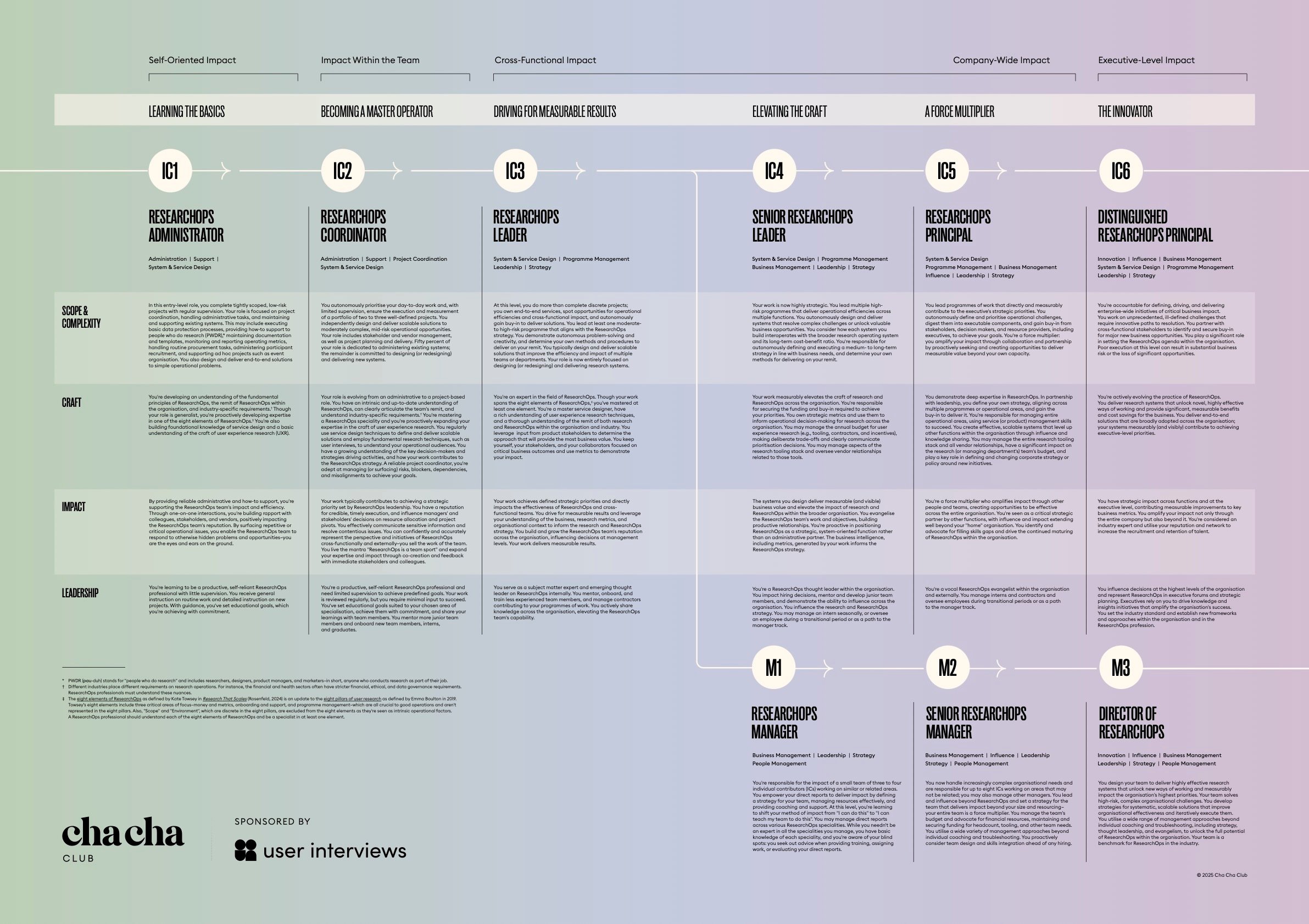
Does your 5-year plan for Research Operations feel... blank? It's more common than you think. The career path for ReOps can feel undefined, leaving talented pros to guess what's next and managers to cobble together reviews. Kate Towsey (the ReOps expert) finally fixed this. She created The Universal ResearchOps Career Ladder, a framework that gives ReOps what every other discipline has: a clear progression. It’s flexible enough for specialists and generalists, and you can use it to advocate for a promotion, write sane job descriptions, or build an entire function.
The future of Research Operations feels full of potential: integrating AI, scaling impact, creating strategy. While the day-to-day is exciting, it's hard not to feel career anxiety when talking with friends or colleagues in more established fields. It’s easy to think, “Is there actually a career path here for me, five, 10 or even 20 years down the road?”
It’s a really common feeling to not know what’s next career wise. While the work is energizing and fulfilling, that doesn't mean most ReOps folks aren't just making it up as they go.
But the Universal ResearchOps Career Ladder changes that. Created by Kate Towsey—ResearchOps expert, founder of the Cha Cha Club, and producer of the ResearchOps 2.0 podcast—this framework gives ResearchOps professionals what every other discipline has had for years: a clear progression from where you are to where you want to be.
Download The Universal ResearchOps Career Ladder (PDF, 16.7MB)
What's a career ladder?
A career ladder (also called a progression framework, skills matrix, or level document) is what managers use to evaluate success in a role and determine promotions. As ResearchOps leader Saskia Liebenberg explains, career ladders are especially valuable for niche roles where precedent is thin and expectations are often unclear.
ResearchOps has matured. Career frameworks haven't.
The State of Research Operations 2025 report shows the gap. Of organizations with dedicated ResearchOps, 41% have one team member, 31% have between two and five, 17% have between six and 19, and 11% have 20 or more.
The work has transformed. Fifteen years ago, ResearchOps meant just scheduling interviews and wrangling participants. Today, ResearchOps professionals design research operating systems, manage programs, and apply service design and product management skills.
But career frameworks lag behind. Even tenured ResearchOps professionals with five or more years of experience struggle to see what comes next. First-time hirers cobble together Research Operations job descriptions that read like wish lists. Managers improvise performance conversations. Talented ResearchOps folks leave because the path forward is invisible.
"I don't quite know where I'll be in five or ten years' time because I don't see a career path that's been clearly carved out for me."
—Respondent, The State of Research Operations 2025
How to use the career ladder
If you're hiring, the ladder shows you what skills each level requires and how they differ. Instead of creating job descriptions that list every possible responsibility, you'll understand what distinguishes a mid-level ResearchOps person from a senior one, and what progression looks like beyond that.
If you're advocating for a promotion, the ladder gives you the evidence and language you need. You'll see what the next level requires and how to explain the difference to leadership clearly.
If you're managing a ResearchOps team, the ladder defines expectations at each level, helps you spot skill gaps, and shows people exactly what to develop to advance.
If you're building a ResearchOps function, the ladder clarifies how responsibilities shift as teams grow, when to hire specialists versus generalists, and how to structure roles that support both the work and the people doing it.
Kate Towsey created this ladder with input from twenty ResearchOps professionals in the Cha Cha Club, a members' club for full-time ResearchOps practitioners. The framework covers the full progression from early career through leadership, with detailed expectations at each level.
Why one ladder works across specializations
ResearchOps spans wildly different specializations: participant recruitment, knowledge management, data governance, ethics and privacy, and more.
Most career ladders require expertise across all specializations at every level. As teams grow and hire specialists—someone who excels at knowledge management, another who owns data governance—that approach breaks down fast.
Kate designed this ladder differently. It's specific enough to guide growth but flexible enough to work for specialists. You can use it whether you're a solo operator or leading a team of twenty. Whether you're in tech, healthcare, finance, or government. Whether your expertise is participant recruitment or repository management.
The ladder scales with you and your team.
Download The Universal ResearchOps Career Ladder (PDF, 16.7MB)
Use it to write job descriptions that attract the right people, prepare for promotion conversations with concrete evidence, run meaningful performance reviews, and build a ResearchOps function that can grow.
Credits
The Universal ResearchOps Career Ladder was created by Kate Towsey. Read more about how it was developed on The ResearchOps Review.