



In our 2025 Research Budget Report, we explored how research teams are funded across industries. But while a $500K budget might feel like a dream for a small research team, it often feels like a squeeze for an enterprise org juggling dozens of priorities and stakeholders.
So we further explored the data to see how budget behaviors shift across company sizes. While it's tempting to think that more money = better research, we found a more nuanced story: Enterprise teams may have the bigger budget, but small and medium sized teams are often leaner, scrappier, and more agile in how they spend.
Here's a look at our findings:
Enterprise budgets are more concentrated in the high investment tier
As a reminder, we broke budgets into four categories: low (<$25K), low-mid ($25K+-$100K), upper-mid ($100K+-$500K) and high investment ($500K+).
Of the bunch, more enterprises operated in the $500K+ budget club. In fact, 38% of enterprise teams land in this high-investment category, compared to just 24% of medium-sized and a modest 5% of small businesses.
.avif)
Enterprise companies have similar spending patterns as smaller companies
While enterprises spend more overall, the allocation of budget is more consistent across company sizes than you’d think.
When we dug into tool spending, we discovered Enterprise companies allocate, on average, 21% of their research budgets on tools, compared to medium (20%) and small businesses (17%). Similarly, enterprise companies allocate more for vendors (12%), compared to medium (9%) and small businesses (10%).
The only noticeable difference came in regards to headcount/staffing: While both small businesses and enterprises dedicate 28% of their budget to this line item, medium-sized businesses invest even more (38%).
.avif)
More medium-sized businesses have their budgets controlled by Research/ReOps, but not by much. Both are more centralized than small businesses
You might expect budget control to be centralized in most enterprise orgs, aka in the hands of Research or Research Operations teams. Surprisingly, this is more of the case in medium-sized companies–but just slightly. With 42% of medium-sized orgs having budgets controlled by Research or ReOps, compared to 39% at enterprises.
Enterprise budgets also saw the most control from Product and Design, with 23% of respondents choosing this option.
.avif)
Enterprise teams commonly have annual budget review cycles
When looking at budget review cycles, 58% of enterprise teams often set their budget annually, compared to 55% of medium-sized companies and 19% of small businesses.
Having a consistent cadence for reviewing budgets can be a signal of maturity, but once it’s locked in at the enterprise level, it may limit flexibility across teams. Teams at smaller companies therefore might opt for a more agile, project-based approach to budget planning.
.avif)
Maturity ≄ bigger budgets at scale
Here is where things get interesting: In our sample, we saw smaller companies having more of a relationship to maturity than medium-sized and enterprise teams. Often, more mature teams got more funding in these companies. This was not the case in enterprise orgs, though. We saw high-maturity teams working with low budgets, and low maturity teams with big ones.
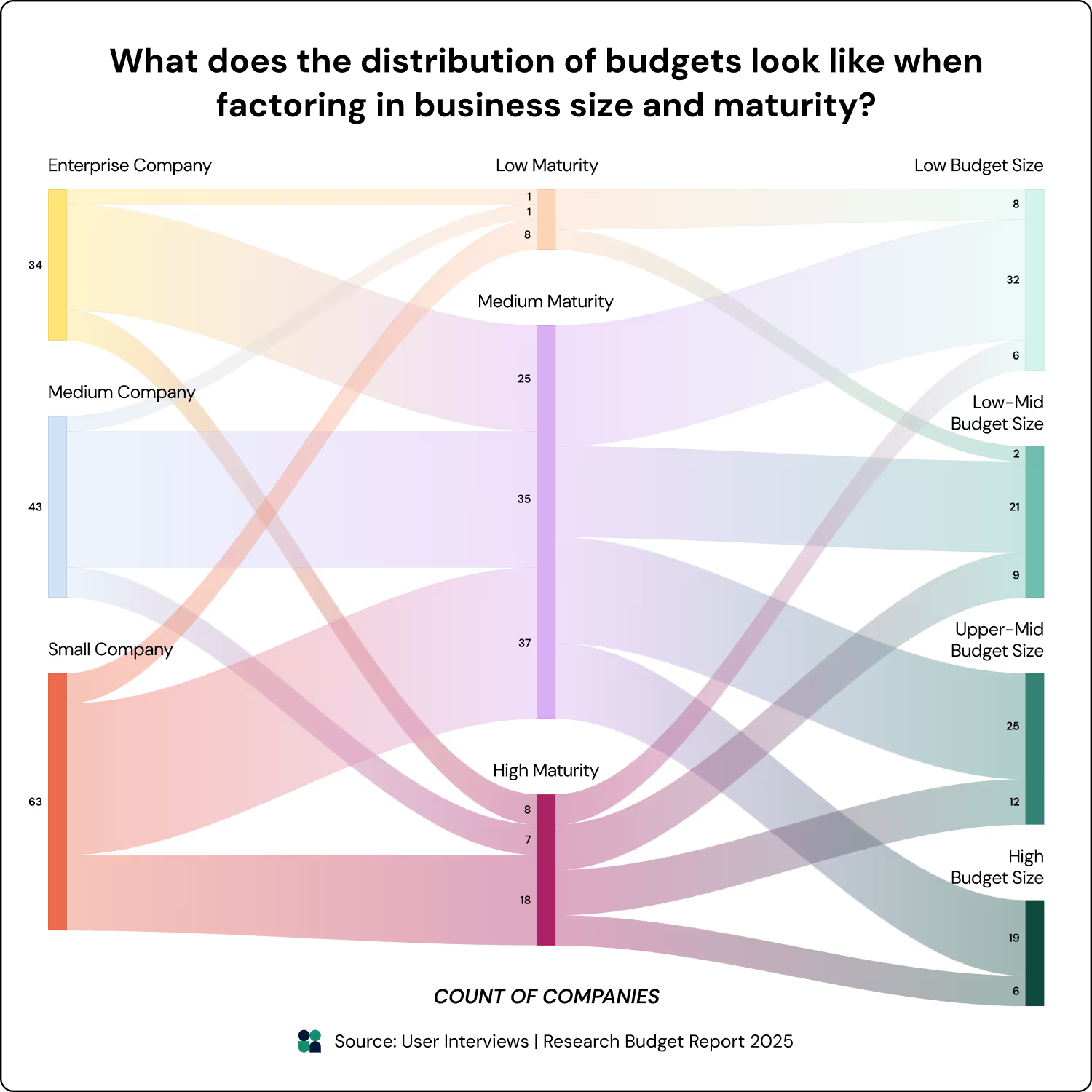
Enterprise teams report lower satisfaction despite larger budgets
You’d think that bigger budgets means happier teams. Not quite! Our analysis showed that 31% of those at enterprises are dissatisfied or very dissatisfied with their research budget, nearly double that of those at small companies (17%).
.avif)
Enterprises struggle with justifying tools, headcount, and exploratory research
Despite their size, enterprise teams face a variety of human obstacles. In fact, 21% of respondents from enterprise teams described tool purchases as a core challenge, stemming from delays from compliance reviews, unclear ROI, or lack of maturity.
“When the department is too small and UX maturity is too low, they don't understand what tool/training is needed for research. They usually tell us to go for the low hanging fruits. All budget focuses on incentives and recruitment. That could eat up the whole budget.”
Similarly, with hiring freezes and high labor costs, 14% of enterprises said their biggest struggle for justification was headcount.
“We rely on product teams to forecast their needs for research but most are not mature enough in their understanding of the role of UXR to include us throughout the lifecycle. So they scramble at various points to find project funding to pull us in. If research was embedded in the lifecycle we could hire more people because the teams would include the resource in their estimates ahead of time”
Additionally, although it seems like enterprises would prioritize exploratory research as a competitive advantage, 12% of respondents from these businesses said exploratory research was their biggest struggle to justify.
"It’s also becoming harder to justify exploratory research due to high cost and the lower perceived business value."
“Foundational field research is most difficult to justify spending because of the high cost (recruitment, incentives, local moderation, translations, travel) relative to a in-lab usability study. Additionally, the research typically isn't tied to a specific business decision or feature launch, so stakeholders don't see the "tangible" benefit.”
Enterprise teams are stable, but not growing fast
Enterprise teams experienced slightly more stability year over year in their budget (45%) than growth (37%)—although this experience was more pronounced for medium sized teams, with 50% of them staying the same year over year and only 30% of them growing.
Small businesses saw the most growth year over year in their research budgets, with 46% of them growing or significantly growing. And medium-sized businesses and enterprises were roughly tied for budget cuts, with 20% and 19% respectively, compared to 16% of small businesses.
.avif)
Final thoughts
The bigger your research team gets, the bigger the budget might be—but that doesn’t mean things get easier. One way to interpret the findings is that in larger orgs, budget size may be more a function of business complexity than research maturity alone. More money often means more people to answer to, more approvals to get through, and more pressure on every dollar spent. It’s not just about how much budget you have, but how spread thin it gets and how many voices are weighing in. That can slow down research and make it tough to get buy-in for the tools, headcount, and projects you really need. At the end of the day, it’s not just about dollars—it’s about cutting through the red tape and finding ways to make your budget work harder for you.
Want more insights?
Check out the full 2025 Research Budget Report and our take on Why Streamlined Tool Stacks May Cost You More.