


If your research reports are landing with a thud, you're likely facing an "empathy gap"—where stakeholders understand the data but don't feel the user's struggle. Wako Takayama’s fix is a Customer Empathy Program. Instead of more slides, she outlines how to create low-budget, hands-on simulations where colleagues perform core user tasks (like "onboarding a new account") without internal shortcuts. It’s a practical blueprint to turn abstract insights into shared organizational understanding.
As a hands-on UX Researcher and Director of a small team, I often wrestled with a familiar challenge: how do you help colleagues not just understand users’ pain points, but feel them?
Research reports and slide decks can build awareness, but that understanding is often intellectual—detached from the messy, emotional reality of the user’s world. Insights may be acknowledged, even admired, but they rarely stick. Without a gut-level connection, creativity and collaboration stall.
This exposes a growing issue among researchers—an empathy gap between researchers and customers.
The problem is amplified in today’s siloed teams. New hires, especially, face steep learning curves. They may master the tech stack and design systems quickly, but few onboarding processes help them internalize what it’s actually like to be the user—to face the constraints, frustrations, and trade-offs our customers live with every day. This disconnect from the user’s experience increases the risk of making decisions that don’t actually address real challenges and solve problems.
This article offers a simple, scalable blueprint for bridging that gap: a hands-on Customer Empathy Program that immerses employees directly in the user experience. It’s a low-cost, high-impact way to build shared understanding, spark collaboration, and make research insights come alive.
A Case Study in Building a Customer Empathy Program
At Clover, a point-of-sale (POS) system for small businesses, new hires needed to quickly grasp the complex realities of small business ownership. The original approach was straightforward but ineffective: each employee was handed a box of brand-new hardware and told, “Go play with it.”
One day, I spotted a dust-covered box under an engineer’s desk. He’d been at the company for nearly a year. That unopened box was the perfect symbol of an empathy gap—one that no amount of documentation could fix.
That moment became the catalyst for the New Hire Merchant Empathy Program. We set out with two clear goals:
- Help new hires understand both our customers and our product by stepping directly into the merchant’s shoes.
- Build immediate, cross-functional connections through a shared, hands-on experience.
Starting on Day 1, new hires—grouped in small, cross-functional teams—were tasked with running a mock business using the Clover product. They became bakery owners, bike-repair shop managers, or boba-café baristas. Each team had to set up their business from scratch, configure sales taxes, and navigate the product as a real merchant would.
This “step into the shoes of” framing unlocked a combination of creativity and empathy at once. Program participants didn’t just learn the system; they lived it. They encountered friction points firsthand and discussed improvements naturally, across roles.
Over time, we refined the program, but the core remained the same: experiential learning that humanized the customer. The impact was immediate and measurable. New hires ramped faster. Cross-functional collaboration deepened. Real issues were addressed more easily. There were excellent internal NPS scores.
Most importantly, the experience created a shared, practical understanding of our users that no presentation could replicate. It transformed empathy from an abstract value into an organizational muscle.
Need to brush up on your fundamentals? Our User Experience Research Field Guide is a great resource for all UXR topics, from recruitment to methods to analysis and reporting.
Creating a DIY Empathy Program: A 4-Step Guide
The good news is that you don’t need budget, permission, or a formal research lab to bring your team closer to your users. What you do need is intention and a lightweight structure. Here’s a simple four-step framework you can adapt to your organization.
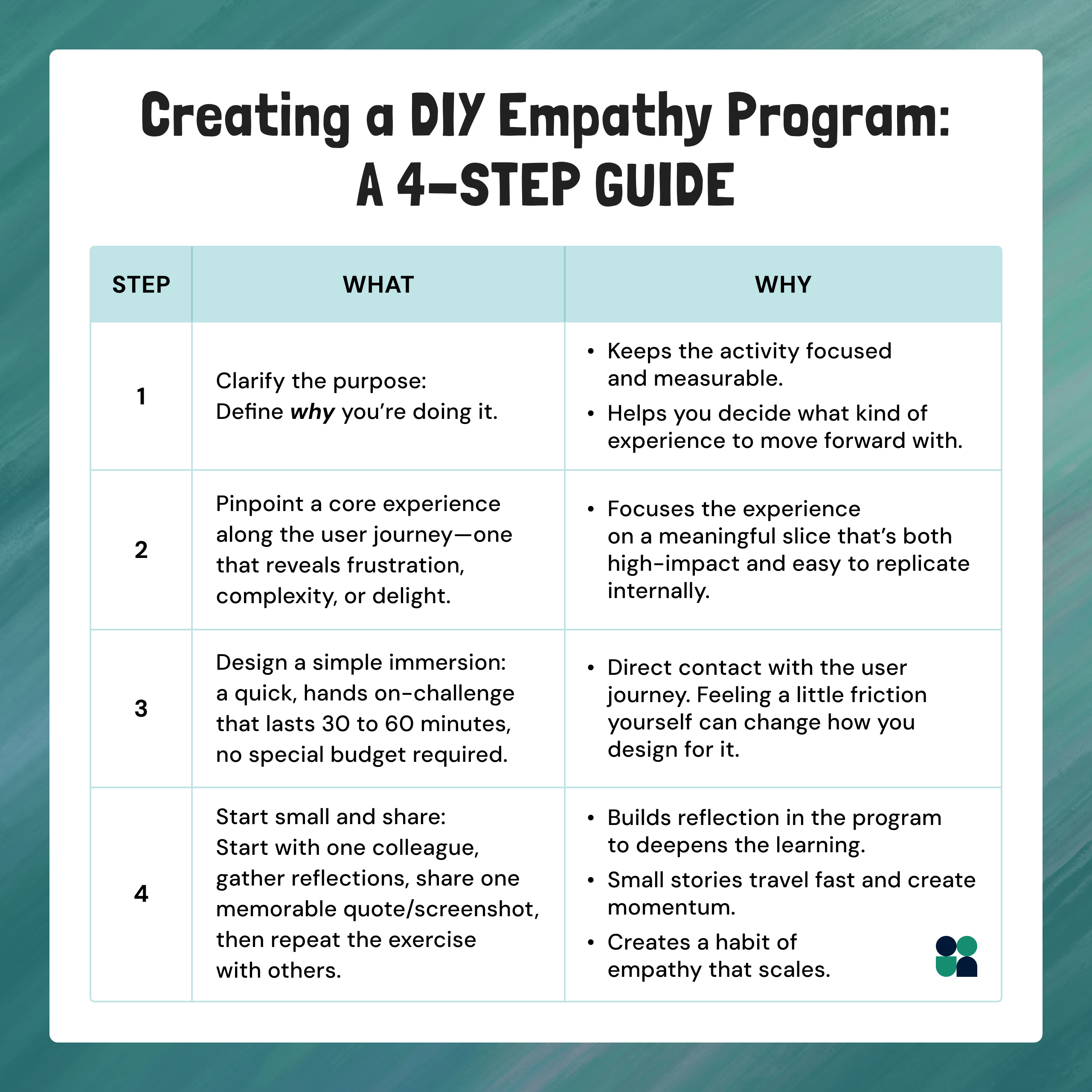
Step 1: Clarify the Purpose
Take a similar approach to building a research study: before you design anything, define why you’re doing it. Is the goal to:
- Help new hires cultivate empathy faster?
- Strengthen cross-team collaboration?
- Inspire better product decisions?
A clear purpose keeps the activity focused and measurable. It also helps you decide what kind of experience will create the right kind of “aha” moment.
For example:
- If you want to speed onboarding, choose an experience that mimics your customer’s first-time setup.
- If your aim is cross-functional collaboration, build mixed teams that rely on one another to solve realistic challenges.
When everyone understands the “why,” the “what” naturally falls into place.
Step 2: Pinpoint a Core Experience Along the User Journey
Now that you’ve clarified your goals, it’s important to ask: What’s one critical moment in your user’s journey that reveals frustration, complexity, or delight?
You’re not recreating the entire product experience—just a meaningful slice. Look for touchpoints like:
- Setting up an account or device
- Completing the first transaction or task
- Recovering from an error or support issue
Choose something that’s both high-impact and easy to replicate internally. The goal is focus, not fidelity.
Step 3: Design a Simple Immersion
Turn that core experience into a quick, hands-on challenge.
Keep it scrappy—30 to 60 minutes, no special budget required.
Examples:
- SaaS: Ask a PM to sign up for a free-trial account and achieve one key goal with no internal shortcuts.
- E-commerce: Have an engineer attempt a return using only what’s on the public website.
- Mobile app: Invite a marketer to complete onboarding on their personal phone and record where they stumble.
What matters is direct contact with the user journey. Feeling a little friction yourself can change how you design for it.
Step 4: Start Small and Share
You don’t need an executive sponsor. Start with one colleague—maybe a designer, engineer, or new hire. Frame it as an experiment: “Want to try something fun to step into the shoes of our customers?”
Afterward, gather a few reflections: What surprised them? What would they fix first?
The methodology for this will depend on the design of your specific immersion experience. It could be a five-minute in-person debrief after the session, or a more formal retro on a Miro board. The key is to design some kind of reflection into the program; it helps to deepen the learning and empathy.
Share one memorable quote or screenshot in Slack or at your next team meeting. Those small stories travel fast and create momentum.
When you repeat the exercise with a few more teammates—or adapt it for a different journey—you’re no longer running a one-off activity. You’re building a habit of empathy that scales.
True Empathy Is Built Through Action, Not Abstraction
A Customer Empathy Program doesn’t have to be a grand initiative—it starts with a single shared experience. When people across teams do something together that mirrors the user’s world, barriers between research, product, and engineering begin to fade. Suddenly, insights aren’t something you hand off; they’re something you build from, together.
In fast-moving organizations, we talk a lot about “breaking down silos.” But slides and summaries rarely achieve that. What does? A 45-minute activity that makes a product manager, designer, and engineer feel the same frustration a customer feels—and then talk about it over coffee.
True empathy is built through action, not abstraction. A small, hands-on exercise can shift perspectives more powerfully than a 50-page report ever could.
So don’t wait for permission or funding. Start with one colleague and one user task. Run the experiment. Share what you learn. That single moment of doing—not discussing—might be the spark that turns empathy into your team’s default setting
With User Interviews, it's simple to run high-quality research with your target audience. It's the only tool that lets you source, screen, track, and pay participants from your own panel, or from our network. Book a demo today.